


Just a selection of some of the images used in my poster yesterday of the classrooms and multimedia centre.


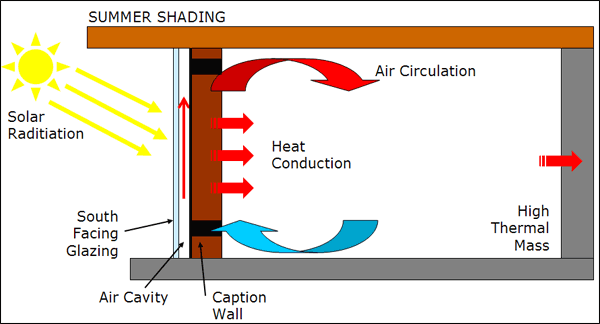 I have decided to incorporate trombe walls into my design, which will be placed at the rear of the classrooms with high windows so that the sun is angled toward them. It was decided that if placed on the exterior of the walls, the glazing would cause the building to loose their rugged aesthetic through the rammed earth and unpolished concrete. The trombe walls will add significant passive heating during the whole day through the thermal mass of the rammed earth, and will keep heating into the evening and night for use of the community. Also, if the temp is kept higher through the night, it will reduce the heating costs the next morning.

 The Harbor house by Stuchbury and Pape in Newcastle, NSW utilizes a good roof system which is designed to take as much sun as possible and through the use of reflection bounce and disperse the light into the parts of the house equitably, angling the most sun into the lounge although maintaining some into the bedrooms and other less used rooms of the house. This form of roofing could be used within the learning spaces of Torquay high school.

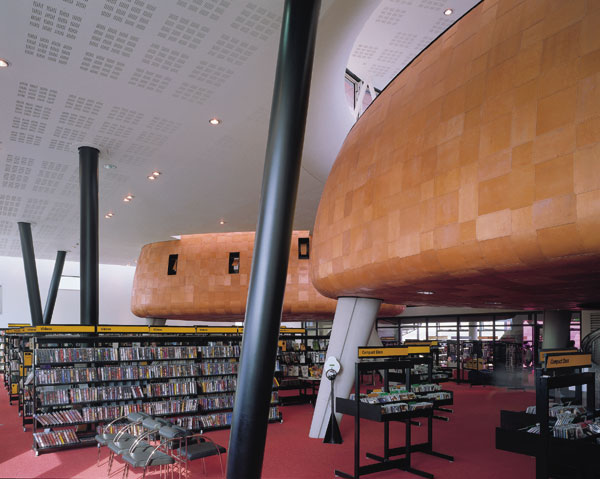 The form of the Peckham Library, in the upside down L, although basic could be rearranged and modified into a set of learning spaces. Since my buildings are located on the southern boundary of the property, the form would allow for wind protection to the north and allow space for outdoor learning areas. The use of the internal space allows for large open spaces as well as smaller pods for individualized learning centers.
 Internal shot toward ocean
 Weaving on external, acting as windbreak


 After going back to the site we were going to design the school on, it was decided that the proposed design would have to accomplish the following goals:


 The Siza/Souto de Moura in London offers a good concept for the roof design. Although this couldn't be used in completion for a classroom, particularly in Victoria, the roofs ability to allow and diffuse natural light could be used. Maybe if the roof on a large pitch to the South or something?
 Example of passive cooling through a classroom
 Some classrooms for primary schools and kindergartens that were researched included lots of light and colours around the room, and big open spaces for communal learning. Some of the other aspects my group decided to incorporate was to reduce the reverberation time and background noise, reduce glare into the classroom while still lighting the space effectively and create a space that could be kept at a temperature where learning and teaching would not be hindered, with a minimal use of heaters and air conditioners.
 Sips roofing
 Structurally Insulated Panels (SIPS) were used our classroom modular design due to their abilities to replace so many components of the classroom sustainably such as studs and joists, insulation and columns. By reducing the need for columns, they also allowed greater space for the classroom to utilize.

 The idea of modular design can be done through the use of crates or shipping containers, which are already transported can be stacked or arranged around one another to may be able to suit a classroom of primary school kids.
 The classroom may be able to be made in a few different parts, and then easily put together on site.
